The Three-Stone Body Layout: A 15-Minute Crystal Meditation for Grounded, Open Awareness
By RedKnotr Editorial - 10/10/2026 - 0 comments
Most crystal advice stops at "hold a stone and breathe." The tradition offers something more precise: the body layout, a fifteen-minute practice in which stones are placed at three points on the body so the mind has a clear job to do. Practitioners say the placement works through the ritual layer — the point where intention, posture, and symbol line up — while the psychological layer does its quieter work of settling attention.
Why placement gives the mind a job
A wandering mind is the main reason beginners abandon meditation. A stone resting on the body is a physical anchor with weight and temperature, and every time attention drifts, the sensation calls it home. Nothing needs to be believed for that mechanism to work; many people find the simple loop of notice-and-return is where the calm accumulates.
Choose three stones, not seven
Full seven-chakra layouts exist, and crystal tradition describes each with its own focus. But a first practice lands better when it is simple: one stone for grounding, one for the heart, one for intuition.
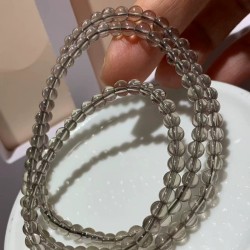
A grounding stone: black tourmaline or smoky quartz
Placed between the feet or at the base of the spine, this is the root of the layout — the stone the tradition associates with safety and physical steadiness.
A heart stone: rose quartz or green aventurine
Resting on the center of the chest, the heart stone is linked with softness and emotional warmth. Its weight is the most noticeable of the three, and that is the point.
An intuition stone: amethyst
Placed lightly on the center of the forehead, amethyst is the stone tradition pairs with inner vision. Keep it small; a heavy stone on the forehead is a distraction, not a practice.
The fifteen-minute layout, step by step
- Lie on your back somewhere you will not be disturbed. Place the grounding stone between your feet, the heart stone on your chest, the amethyst on your forehead.
- Take five slow breaths. Feel each stone's weight and temperature — cooler, warmer, heavier, lighter. Just notice.
- Bring awareness to the grounding stone for two to three minutes. If imagery helps, picture roots extending from you into the floor.
- Move attention to the heart stone. With each breath, imagine soft pink or green light widening through your chest. Two to three minutes.
- Shift to the amethyst. Let any images or impressions arise without chasing them. Three to five minutes.
- Expand awareness to all three stones at once — a column from feet to forehead — and rest there for about five minutes.
- Take three deep breaths, remove the stones from the top down, and sit up slowly.
Prefer to sit? The two-hand hold
If lying down is not practical, sit and place one stone in each palm. In crystal tradition the left hand is often called the receiving hand and the right the projecting hand — many practitioners suggest a calming stone in the left and a clarifying one in the right. Rub a thumb over the surface on each exhale; restless hands get a job, and the exhale gets a rhythm.
What you might feel, and what it means if you feel nothing
Warmth, heaviness, a gentle pulse of emotion, or very little — all of it is normal. Practitioners are consistent on this point: quiet does not mean nothing is happening. Regulation often arrives beneath conscious sensation, and measuring the experience is the fastest way to lose it. Consistency matters more than intensity; three short sessions a week will teach your body the familiar descent into stillness faster than one heroic hour.
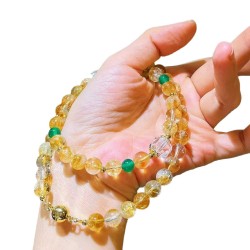
If you want the layout to travel with you, a wearable version of the same trio works as a portable cue — the crystal pieces at RedKnotr are chosen with exactly this kind of daily practice in mind.
Preparing the space, closing the practice
A little framing turns the layout from an experiment into a ritual. Before you begin, practitioners suggest a simple transition: dim the lights, silence the phone, and state a plain intention — "I am here to settle" is enough. Cleanse new stones beforehand by whichever method the tradition you follow prefers; moonlight overnight or a pass through smoke are the classics. When you finish, close with a moment of gratitude — one line toward the stones, one toward yourself for showing up. Ritual closure signals to the body that the practice is complete, which makes it easier to return tomorrow. Over weeks, the whole sequence becomes a doorway your nervous system recognizes on contact.
FAQ
Do I need to cleanse the stones first?
Tradition suggests cleansing a new stone — moonlight, smoke, or sound are common methods — and many practitioners recommend a quick reset before layout work. Others hold that regular use harmonizes a stone naturally. Either approach is consistent with the tradition.
Can I use crystal jewelry instead of loose stones?
Yes. Worn pieces keep physical contact and can support the same embodied awareness, especially when you touch them deliberately during the practice.
How often should I do the body layout?
As often as it serves you. Some people fold it into a weekly wind-down; others reach for it on heavy days. There is no required schedule in the tradition — only the invitation to return.
Tags: crystal meditation, body layout, grounding stone, crystal energy, three-stone practice
✧ Go deeper ✧
Explore more, shop the crystal, dive into the topic
Explore more articles
View all articles →- The Piezo Perspective: What Quartz Science Can and Cannot Tell You About Crystal Energy (October 2026) 18/10/2026
- Raw Edge or Smooth Palm: A HAND Method for Choosing Between Raw Crystals and Tumbled Stones (October 2026) 17/10/2026
- Point, Sphere, Tower, Palm: Choosing a Crystal by Shape Instead of by Hype This October 2026 17/10/2026
- The Bedside Stone: A Two-Minute Evening Ritual Around One Crystal This October 2026 16/10/2026

This content is copyrighted by its original authors. In case of any infringement, please contact us for removal.
Comments
Write a comment