Learning to Trust My Crystal Pendulum: Six Months of Small Questions
By RedKnotr Editorial - 23/10/2026 - 0 comments
The Pendulum That Sat in My Drawer for Six Months
There's a small amethyst pendulum in my desk drawer — a hexagonal point on a brass chain that came to me secondhand, tucked in a box of odds and ends a friend was clearing out. For six months it stayed there, coiled like a question I didn't know how to ask. I'd take it out occasionally, hold it very still, and feel slightly ridiculous. Then back in the drawer.
I'd wanted a crystal pendulum for years before I actually used one. Turns out those are different things.
My First Session Was a Disaster, and It Taught Me the Rules
When I finally sat down with it, I did what I assume everyone does: I asked it the biggest question in my life. "Should I move cities?" I watched the stone swing — or twitch — and got nothing I could trust. I asked again, differently. It changed its mind, if it had one. I put it back in the drawer for another two months.
That failure taught me more than any guide did. I'd broken every rule the practice actually runs on: my elbow wasn't rested, my body was buzzing with coffee, the question was enormous, and I desperately wanted one particular answer. A pendulum, I learned, is a translation device, and translation fails when the signal is buried in noise.
How It Actually Works — Both Lenses, Honestly
Here's the map as I've come to hold it, wearing both hats at once.
The plain-science lens first: the movement is real and involuntary. Researchers call it the ideomotor effect — tiny muscle movements you don't consciously command, amplified by the long chain into visible swings. Nobody is fooling themselves on purpose; the hand genuinely doesn't know it's moving. Whatever else you believe, that much is solid ground.
Then the lens I practice from. In the dowsing tradition, that mechanism is the feature, not the bug: the pendulum is a way of making the subtle visible — translating what your deeper mind already knows into a motion your eyes can watch. You're not consulting an oracle. You're giving your own knowing a readable dial.
And the crystal itself? I read stones through four layers: the physical layer (a stable, ordered molecular structure — quartz and amethyst are among the most ordered materials in nature), the psychological layer (a focal point that steadies scattered attention), the symbolic layer (amethyst's long association with intuition and calm discernment), and the ritual layer (the intention you set when you pick it up). None of the layers require the others to matter. Together they explain why a stone on a cord behaves so differently from a button on a string, even if a button on a string technically works too — old dowsers used bent coat hangers.
The Practices That Turned the Drawer Stone into a Tool
Calibration, every single session
Before anything else, I rest my elbow on the table, let the stone hang still, and say "Show me yes," then "Show me no," then "Show me unclear." Mine circles clockwise for yes, swings side to side for no, and wobbles diagonally for unclear. I write the pattern down and verify it with a known-answer question — "Is my name ___?" — before asking anything real. The days I skip this are the days I get gibberish.
Small questions only, at least at first
For the first month I asked things I could verify: "Did the package arrive today?" "Is the basil on the windowsill thirsty?" This felt silly and turned out to be essential. It built something like baseline trust in my own signals, and it kept me emotionally neutral, which — I can't stress this enough — is the whole game. Questions I'm attached to get garbage answers. I ask those in writing instead, where I can't rig the dial.
The two-minute morning check-in
Most mornings now, the pendulum gets two minutes: one small, honest question about the day — "Will a walk help this morning?" — and then I put it down regardless of the answer. The discipline matters more than the answer; using it constantly would turn a quiet practice into a slot machine. On the days the stone hangs dead still, I've learned to read that as "wrong question, or wrong time," and I don't push.
The monthly clean and quiet
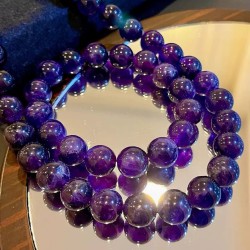
Once a month the pendulum rests overnight on a selenite plate, then back in its little pouch — mine lives beside the amethyst necklace I wear most days, from RedKnotr, though the necklace stays a companion and the pendulum stays an instrument. The cleansing is less about metaphysics for me than about states: a tool that lives in the same pocket as ordinary life reads like ordinary life.
The Drawer Is Empty Now
The pendulum sits on my desk in a small wooden bowl, uncoiled. I still ask it fewer questions than you'd think — maybe three a week, all small. The big questions I've learned to sit with the slow way, the way everyone must.
What changed wasn't the stone. It was my willingness to be wrong in small, low-stakes ways until the signal got legible. I'm still calibrating, honestly. Six months in, the clearest thing the pendulum has ever shown me is how rarely I ask myself what I actually think until something swings.
Questions I Had Myself (and Get from Others)
So is it magic, or is it just my hand moving?
Both readings exist, and I hold them together. The movement is my hand — the ideomotor effect is real. What the tradition adds is a claim about what the hand is translating. I can't prove the second part to anyone. I can only say the practice has surfaced things I knew and hadn't admitted, which is worth the ten minutes either way.
Do I need a "proper" crystal pendulum?
Any weighted object on a cord works mechanically — a ring on thread is the classic beginner's improvisation. But in my experience the crystal versions earn their keep through the symbolic and psychological layers: amethyst for intuition-flavored questions, clear quartz for clean, readable signals. Choose the one your hand rests on without argument.
Why did mine stop answering?
Usually one of three things, in my experience: you're asking something you're too attached to, you're tired or jittery, or the question needs reframing. Take the "maybe" signal seriously — it often means the timing's off, not that the tool broke. Rest, cleanse, come back smaller.
Can I ask about other people?
I don't, and the guides I respect say the same. Questions about someone else's private thoughts are both ethically murky and practically useless — the signal is noisy. Ask about yourself, your timing, your readiness. That's where the practice pays.
Tags: crystal pendulum, pendulum dowsing, dowsing practice, amethyst
✧ Go deeper ✧
Explore more, shop the crystal, dive into the topic
Explore more articles
View all articles →- Many Points, One Base: Why a Crystal Cluster Works Differently From a Single Point (October 2026) 22/10/2026
- Sun, Water, Salt: A Practical Guide to What Actually Damages Your Crystals 22/10/2026
- A Five-Minute Bedside Crystal Ritual: Amethyst, Lepidolite and the Wind-Down Your Evenings Are Missing 21/10/2026
- The Bowl Beside the Stone: What Sound and Resonance Teach You About Listening to Crystals (October 2026) 20/10/2026


This content is copyrighted by its original authors. In case of any infringement, please contact us for removal.
Comments
Write a comment