Point, Sphere, Tower, Palm: Choosing a Crystal by Shape Instead of by Hype This October 2026
By RedKnotr Editorial - 17/10/2026 - 0 comments
When people shop for crystals, they usually start with the stone: amethyst for calm, citrine for optimism, black tourmaline for protection. Yet experienced practitioners often say the more practical question is not which mineral, but which shape. A crystal's form does not change what it is, tradition holds, but it changes how you hold it, where it lives, and how your attention meets it during practice. Understanding the common forms turns a pretty purchase into a working tool.
Why Shape Matters in Crystal Practice
In crystal energy work, the mineral sets the theme and the shape sets the delivery. Practitioners describe points as concentrators, spheres as radiators, clusters as broadcasters. Whether or not one takes the vibrational language literally, the psychological layer is easy to verify: a sharp tower on a desk invites a different gesture than a smooth palm stone in a pocket. Shape changes posture, and posture changes practice. Many people find that matching form to intention is what finally makes a daily ritual stick.
The Six Everyday Forms
Points and Towers: Direction and Focus
A single-terminated point or a standing tower is the classic focus tool. Points are used to direct attention, whether toward a written intention on an altar or inward during a work session. For goal-focused weeks, a tower on the desk works as a physical cue: see the point, return to the task. Towers chip easily at the tip, so give them a stable, undisturbed spot.
Spheres: Even, Gentle Presence
Spheres radiate evenly in every direction, which is why practitioners choose them for ambient calm in shared rooms rather than for pointed intention. A sphere in a living space reads as softness and completeness, and many people find it the easiest form to gaze at during a short breathing pause.
Palm Stones and Tumbled Stones: Portability
Polished palm stones and small tumbled stones are the everyday carriers. They survive pockets and bags, warm quickly in the hand, and suit touch-based rituals such as pressing a thumb into a worry stone during a tense call. If your practice lives outside the house, start here.
Clusters and Geodes: Shared-Space Cleaners
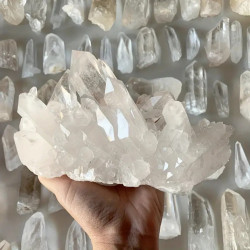
Clusters are families of points on one base, and geodes are hollow rocks lined with crystals. Tradition holds that clusters broadcast and refresh the energy of a room, and they are also the form practitioners most often use to rest other stones on between uses. Place them where people gather rather than in private corners.
Pyramids: Grounded Amplification
A pyramid gathers at its broad base and rises to a single apex, a shape long associated with stability feeding ascent. Practitioners use pyramids for manifestation work that needs grounding: intentions about career, home and money rather than moonlit wishes.
Hearts: Emotional Focus
Carved hearts are shaped reminders. The form directs attention to the chest, and many people keep one visible during difficult conversations or journaling about relationships. As gifts they carry the message without a single word.
Matching Form to State
Choose by what you need, not by what looks best on a shelf. For focus work, pick a point or tower. For a calmer room, a sphere or cluster. For practice that travels, palm and tumbled stones. For grounded intentions, a pyramid. For emotional weeks, a heart. When torn between two, practitioners offer a tiebreaker that costs nothing: take the one your hand keeps returning to. Physical resonance, in this tradition, is the shortest route to consistent use, and consistency is where the practice actually lives.
Care follows form as well. Points and towers want padded storage and careful handling; spheres need a stand or soft pouch because they roll; clusters dislike dusting with anything harder than a soft brush. Water and sunlight are the two classic cautions, as some stones are sensitive to one or both, so check before any cleansing routine.
If you would like a tangible anchor for these practices, the crystal and geometric jewellery at RedKnotr is designed to be worn, touched and lived with, not just admired.
Frequently Asked Questions
Do crystal shapes really change a stone's energy?
Tradition holds that shape directs how the stone's qualities are engaged. Practitioners treat shape as the delivery method: it changes how you interact, which changes how the practice works for you.
What is the best crystal shape for beginners?
A tumbled or palm stone. It is affordable, durable, portable, and it invites the daily touch that builds a lasting habit.
Can one crystal be used in several shapes?
Yes. Amethyst as a geode, a sphere and a palm stone serves three different situations, which is exactly why practitioners often keep one stone in several forms.
How do I cleanse a carved shape safely?
Check water and sunlight sensitivity first. For most polished shapes, a brief pass through smoke, sound or a rest on a larger cluster is a gentle default.
Tags: crystal shapes, crystal points, palm stones, crystal care
Related Pieces
View All →

This content is copyrighted by its original authors. In case of any infringement, please contact us for removal.
Comments
Write a comment