Between the Brows: A Working Third-Eye Practice for the Decisions You Keep Second-Guessing (October 2026)
By RedKnotr Editorial - 21/10/2026 - 0 comments
Between the eyebrows, in the space most traditions mark as the sixth centre, sits Ajna, the third-eye chakra. Its colour is deep indigo, its element is light, and its lotus is drawn with only two petals, the minimum in the whole chakra system, as if the point were not to accumulate but to focus. Its seed mantra is OM, the sound most traditions pair with beginnings, which is fitting for a centre whose work is to see clearly what is actually starting.
What intuition actually is
It helps to be honest about the third eye from the start. The traditional correspondences are beautiful: Ajna is linked with the pineal gland, the small endocrine structure that produces melatonin and helps time your sleep-wake cycle, and with inner vision in general. But the practical meaning of a "balanced third eye" is less mystical than the posters suggest and far more useful. Intuition, in working form, is compressed experience: the pattern-recognition output of everything you have already lived, surfacing as a feeling before it can be verbalised. The firefighter who leaves the building seconds before it fails is not prescient; the pattern arrived early and wordless.
Read this way, the third eye is not a window into other worlds. It is the credibility you extend to your own pattern-matching, and like any credibility it can be under-used and over-used.
When the centre runs low
An under-active third eye shows up less as blindness than as second-guessing. You make the sensible choice and then re-litigate it for a week. You ask three friends what you should do about a decision only you can make. You defer to logic so completely that your first instincts never get counted, and therefore never get calibrated. The centre is not blocked so much as out of practice.
When it runs hot
The overactive version is just as real: daydreaming that displaces action, seeing omens in every coincidence, treating every dream as an instruction. A healthy third eye makes predictions and checks them. An inflated one collects only the hits and forgets the misses.
Five working practices
- The small-trust experiment: once a day, make one low-stakes decision on first instinct, before analysis wakes up. Which route to walk, which message to answer first, which of two stalls to buy from. Before you check the outcome, commit a guess aloud. Log it in one line. The point is not to be right; it is to give the instrument enough repetitions to tune.
- Trataka, candle gazing: the classic yogic drill for attention. Place a candle at eye level, about two feet away. Gaze softly at the flame without forcing, and when your eyes water, close them and hold the after-image at the space between the brows. A few minutes is plenty; never leave a flame unattended, and skip it entirely if you are prone to headaches.
- The dream margin: keep a notebook by the bed and write one line before checking the phone. Not interpretation, just capture. Over weeks the themes repeat loudly enough to be useful, and the habit alone signals to the deep layers that their output gets read.
- Limit the input flood: the third eye's raw material is signal, and modern days are mostly noise. One deliberately boring moment a day, a walk with no podcast and no screen, is the cheapest clarity practice there is. Attention recovers like a muscle; it only needs the gym to close occasionally.
- Alternate nostril breathing: three minutes of nadi shodhana, closing one nostril at a time and alternating slow breaths, settles the nervous system enough that the quieter signals become audible. It is preparation, not magic, but preparation is most of the game.
Indigo stones as tactile cues
The stones traditionally assigned to Ajna, amethyst, lapis lazuli, sodalite and fluorite among them, work best by the same honest standard as the rest of the practice: as cues, not switches. A small indigo piece on the desk or worn on a cord gives the hands a place to land at the exact moment a decision is due, and that touch can be trained to mean one thing only: pause, and check what you already know. The stone does not produce the insight. It marks the doorway the insight walks through, which in daily life is most of what we actually need from an object.
Two journaling prompts
Once a week, answer one of these in writing, slowly. First: when did I disregard a knowing this week, and what did following it later cost me? Second: what distinguishes, in my own recent experience, between a fear-shaped thought and an intuition-shaped one? Most people discover their own reliable tells: fear repeats itself urgently and in circles; intuition tends to arrive once, quietly, and remains. Your tells are worth more than anyone's generic checklist, which is rather the whole point of the centre.
A Sunday walk to close the loop
End the week the way the tradition suggests the centre is kept healthy: with a little distance. Take a walk after dusk, look at the horizon, and let the week's decisions pass in review without prosecuting any of them. Note one instance of good knowing and one instance of noise, and let that be the whole report. The third eye is not built in a weekend or opened by a purchase; it is tuned, the way an ear is tuned, by attention that comes back often enough to matter.
For a small indigo piece to serve as that daily tactile cue, you can browse the wearable options at https://www.redknotr.com/.
Related Pieces
View All →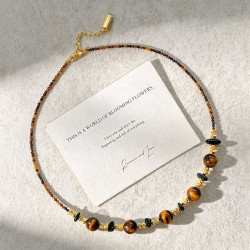





This content is copyrighted by its original authors. In case of any infringement, please contact us for removal.
Comments
Write a comment