The Finger That Never Stops Pointing: Reading a Yod as a Practice of Adjustment (October 2026)
By RedKnotr Editorial - 30/09/2026 - 0 comments
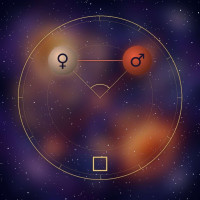
Some chart patterns announce themselves. A grand trine hums along; a T-square pushes until you deal with it. Then there is the Yod, sometimes called the "finger of god": a long, narrow triangle formed by two planets in sextile, each of them quincunx (150 degrees) to a third planet that sits at the point. Where the other patterns build rooms, the Yod builds a doorway that keeps swinging shut until you learn the trick of it. Psychological astrology reads it not as fate, but as a recurring assignment - the one theme in your life that asks to be adjusted again and again.
What a Yod Actually Is
Find two planets roughly sixty degrees apart, within a tight orb. Then check whether each of them also sits about 150 degrees from the same third planet. If they do, you have a Yod, and that third planet - at the sharp end of the triangle - is called the apex. Because the geometry is exact, astrologers tend to keep the orbs narrow; a loose near-miss is not really a Yod. Some charts carry two Yods sharing one apex, sometimes called a double Yod, and practitioners say those people often feel pointed at from two directions at once.
The name comes from the Hebrew letter yod, the smallest in the alphabet, which esoteric tradition links to a spark of divine action. You do not need to accept the mystical framing. The psychological reading works on its own: this is a configuration built almost entirely out of quincunxes, and quincunxes are the awkward angle of the zodiac.
Why 150 Degrees Feels So Different
Every major angle shares something between the two signs involved. A trine connects signs of the same element; a square links signs of the same modality; an opposition sets two signs of the same axis face to face, so at least they recognise each other. A quincunx connects signs that share nothing - not element, not modality, not polarity. The two planets have no natural language in common. Tradition holds that this is why the angle feels like friction without drama: not a fight, not a flow, just a permanent sense that the two things do not quite fit together.
Inside the Yod, the two base planets get along. Their sextile is easy, even friendly. But the way their combined energy reaches the apex is awkward, so the apex planet lives under a quiet, continuous pressure. Astrologer Howard Sasportas pictured the two base planets as a lasso around the apex star - the place where you have particular work to do. Many people with a strong Yod describe the same sensation: a theme they can never quite close, an area of life where every solution works once and then needs revising.
The Apex Planet: Where the Pressure Lands
To read a Yod, start at the point. The apex planet's sign and house describe where the recurring adjustment happens. Saturn there might mean authority and self-discipline keep demanding renegotiation; Venus there might mean relationships and self-worth never feel finished. The two base planets are the support crew: their sextile represents talents that feed the apex, skills that want to be used in service of the pointed-at theme.
The trap, in the psychological tradition, is treating the apex as a burden to escape. A more workable frame is a single assignment. You would not call a job "cursed" because it takes years; you would call it a career. A Yod responds to the same patience. It is not a cosmic verdict - most traditional astrologers treated it as a minor pattern - but for the person who has one, it is usually the most honest question in the chart.
A Twenty-Minute Yod Audit
Once a month, sit with your chart for twenty minutes and try four steps:
- Locate the finger. Identify the two sextile planets and the apex. Note the apex sign and house in one sentence.
- Name the recurring theme. Finish the sentence: "The area of life I keep having to re-adjust is..." Be concrete - "asking for help at work", not "career".
- Collect three recent moments. List three times in the past year the theme reappeared and you had to adapt again. What was adjusted each time?
- Take one small action. Choose a single step that honours the apex on purpose this month, however minor - a conversation, a boundary, a routine tweak.
Repeat the audit monthly. The Yod does not reward once-and-done solutions; it rewards rhythm. Many people find that after a few cycles, the feeling of being haunted by the theme softens into something more like craftsmanship.
Living With a Long Assignment
What the Yod ultimately teaches is adjustment as a skill rather than a failure. The quincunx is the angle of translation between incommensurable things, and people who carry one often become exactly that: translators between worlds that do not speak to each other - the practical and the creative, the family's expectations and the self's direction. The friction does not disappear. It becomes material. If you are exploring your own chart patterns this autumn, browsing the pieces at redknotr.com can be a small ritual of choosing a symbol to wear while you do the deeper work.
Frequently Asked Questions
Is a Yod really "destiny"?
Astrologers discourage that reading. It is a recurring growth theme, not a fixed outcome. The apex describes where life keeps asking for adjustment; what you do there stays yours.
What if my orbs are wide?
Precision matters for this pattern. Most practitioners keep the quincunxes within a few degrees; a loose configuration is better read as two separate quincunxes than as a true Yod.
Can a Yod be activated by transits?
Yes. When a transiting planet reaches the apex, many people feel the theme intensify for a few weeks. It is a useful window for the monthly audit rather than a reason to fear the season.
Does a double Yod mean double trouble?
Two Yods sharing an apex simply concentrate the focus. Practitioners suggest working on one assignment at a time and letting the second pattern orbit until the first is steadier.
Tags: yod astrology, quincunx, apex planet, birth chart patterns, psychological astrology
Related Pieces
View All →


You May Also Like
All Articles →


This content is copyrighted by its original authors. In case of any infringement, please contact us for removal.
Comments
Write a comment