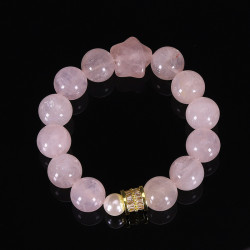
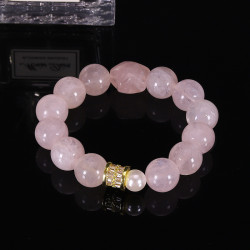
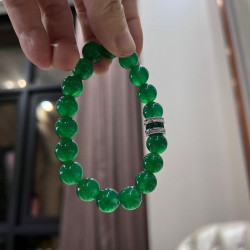
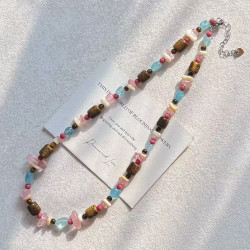
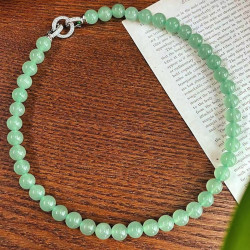
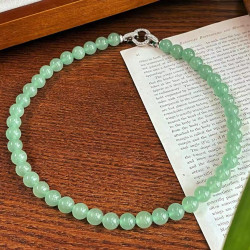
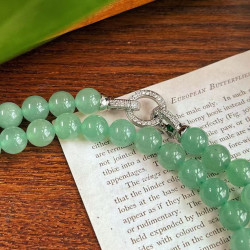
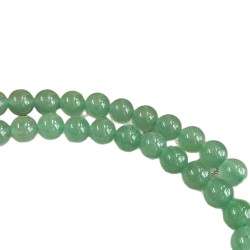
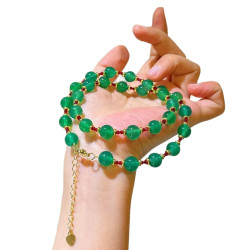
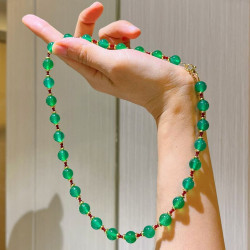
Rose Quartz
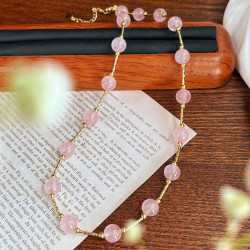
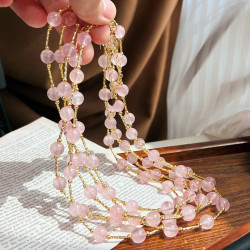
Rose quartz is the pink variety of quartz, colored by trace titanium, iron or manganese. It is a true quartz at Mohs 7, so it is one of the few pink stones that survives daily wear. Below is our rose quartz range — mostly necklaces and pendants, where the soft translucency shows best.
The Stone Itself
Rose quartz is SiO2 with color centers created by trace elements — most commonly titanium, iron or manganese, sometimes with microscopic rutile fibers that produce a faint asterism (a six-rayed star) in the best material. Mohs 7, specific gravity 2.65, translucent to nearly opaque, with a cloudy "milky" appearance that comes from internal microscopic inclusions.
Massive rose quartz forms in huge pegmatite bodies rather than as individual crystals; well-formed single crystals are rare and mostly from Brazil and Madagascar. Because it is abundant, genuine rose quartz is inexpensive — which matters, because dyed glass and dyed quartz are common substitutes.
Meaning and Tradition
Rose quartz is the best-known stone of the heart chakra, associated in crystal tradition with gentleness, self-acceptance and emotional steadiness. It appears in the myth of Aphrodite and Adonis, in Egyptian cosmetic use, and in Roman seal stones. In astrology it is most often assigned to Taurus and Libra. The honest framing: it is a very old symbol of softness, and it is the stone people give each other when they want to say something without saying it.
Telling Natural from Dyed
- Color is soft, not saturated. Natural rose quartz is milky pale pink. If the pink is evenly bright and slightly neon, suspect dye.
- Look for cloudiness and inclusions. Perfectly clear pink is more likely glass or synthetic.
- Check the drill holes. Dye often collects in the holes and along fractures, showing darker.
- Sun exposure fades it. Genuine rose quartz gradually loses color in strong direct sun — a useful, if slow, confirmation that it is natural.
Choosing a Form
- Necklace — the most popular rose quartz form, because the stone reads as soft rather than bright on a strand.
- Pendant — good for a single polished drop; safe from abrasion.
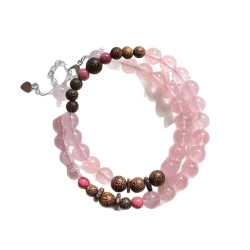
- Bracelet — perfectly wearable at Mohs 7, though the pale color shows scratches more than darker stones.
- Earrings — small drops and studs, light and undemanding.
Care
Warm water and mild soap are safe; ultrasonic cleaning is generally acceptable. Keep it out of long direct sun to preserve color, and store away from harder stones. Rose quartz is tough but not immune to chips on thin carved edges.