Tiger's Eye
Tiger's eye is quartz that grew as parallel asbestos fibers which later dissolved and were replaced by silica — the result is a stone that appears to shift and glow as it moves. At Mohs 7 it wears like any quartz, so bracelets and necklaces both hold up. Below is our full range, including multi-tone strands.
How the Shimmer Is Made
The effect is called chatoyancy — literally "cat's eye." Tiger's eye began as crocidolite (blue asbestos) fibers laid down in parallel; silica later replaced the fibers while keeping their alignment. Light reflecting off those parallel channels produces a moving band of light that sweeps across the stone as you turn it. This is a physical, reproducible optical effect, not a coating or a treatment.
Hardness is Mohs 7 (it is a quartz), specific gravity around 2.64–2.71, and it is usually cut en cabochon or as beads so the band faces the viewer. The untreated stone is golden brown. When the original fiber was less oxidized, the result is blue-grey hawk's eye; heating the brown material produces the deep red-brown sold as bull's eye. Both are the same mineral in a different oxidation state.
Meaning and Reputation
Tiger's eye has one of the more consistent symbolic records of any stone: Roman soldiers carried it as a protective talisman, and in Chinese and Indian tradition it is associated with courage, focus and the ability to see a situation clearly. Modern crystal practice ties it to the solar plexus chakra and to the lower three chakras, and in astrology it is usually given to Leo and Capricorn. Whether or not you take the metaphysics seriously, it is one of the few stones whose reputation — steady, unflashy confidence — matches how it actually looks.
Choosing a Piece
- Look at the banding. A strong single line of light that travels across the bead as it rotates indicates high-grade material. Washed-out, dull surfaces usually mean the fiber alignment is poor.
- Bracelet vs necklace. A bracelet is the classic form because stacked beads show the phenomenon repeatedly. A necklace shows larger uninterrupted bands.
- Beware "tiger's eye" that is too uniform. Reconstituted or dyed material loses the fine internal fiber structure.
Care
Warm water, mild soap, soft brush. Tiger's eye is durable, but it is fibrous in origin and can dry out — avoid leaving it in direct sun or very dry heat for long periods, and avoid ultrasonic cleaning on older pieces with visible surface cracks.

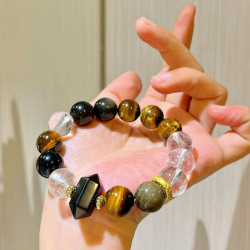


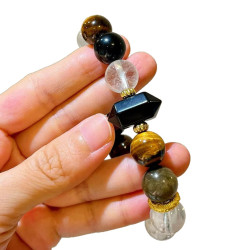






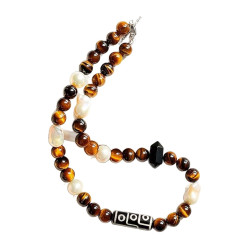




Natural Citrine Tiger's Eye Bracelet

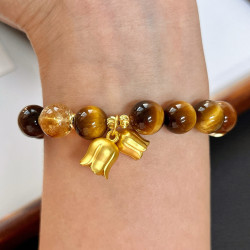






Natural Tiger Eye Citrine Beaded Bracelet Warm Brown

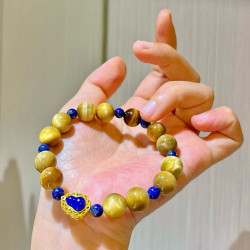


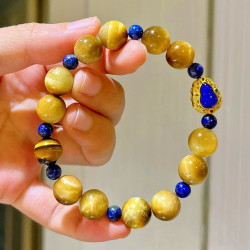

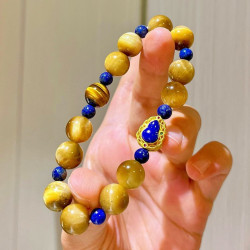
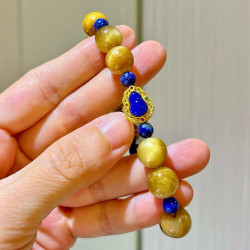
Natural Tiger Eye Lapis Lazuli Designer Beaded Bracelet




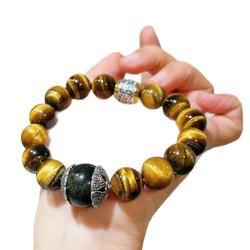


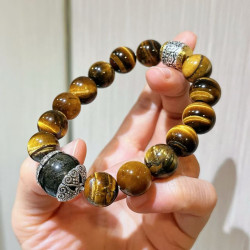

Natural Tiger Eye Silver Obsidian Men's Beaded Bracelet