Blue Is the Color of Distance, and My Drawer Is Full of It
By RedKnotr Editorial - 07/10/2026 - 0 comments
Eleven Shirts, Seven of Them Blue
I counted once, on a Sunday, with the wardrobe open and nothing else to do. Eleven shirts. Seven of them blue, in shades that range from a washed-out sky to something close to navy. I hadn't planned any of it. I buy blue the way other people buy black — as a decision I don't have to make at seven in the morning. I write about color energy for a living; I had never once applied it honestly to my own drawer.
In a fitting room I hold a blue shirt up under my chin and my face looks calmer, and I have been taking that calm as evidence for about a decade. What I noticed only this year is the other thing blue does for me. It's the color I put on when I don't want to be found. Not hidden, exactly. Further away.
My First Attempt Was "Add Warmth," Which Failed Immediately
I decided the blue was a problem and bought a rust-colored knit. I wore it once, to a meeting, and spent the whole hour feeling like a house with the curtains open. Nothing bad happened. I was simply more visible than I had agreed to be, and I didn't like it.
That reaction was more interesting than the color theory. If blue were merely calming, a warm jumper should have been neutral, not exposing. So the question changed. Not what does blue do but what am I using it to do.
Color Energy Isn't a Personality Test
The framework I work with has three layers, and the order matters, because most color writing starts at the third one and works backwards.
The first layer is visual. Where the eye goes, how much work it does, whether an edge resolves. Blue sits at the short end of the visible spectrum; in a landscape it's the color of things far away, because air scatters short wavelengths and everything distant goes blue. That's not poetry, it's the reason distance looks the way it does. Blue is literally the color of far.
The second layer is bodily. Cool colors tend to lower arousal — slower, quieter, less urgent. Here I have to be careful, because the research is less tidy than the summaries suggest. One much-cited experiment had people sit in red and blue rooms and found slower heart rates in the red room, which is the opposite of what the internet says. Another found the blue room raised a particular waking brain rhythm. My honest reading: the effect is real, small, and heavily dependent on context and on the exact blue. Anyone who tells you blue lowers your heart rate by a specific amount is selling something.
The third layer is memory. Blue is the most-named favourite color in survey after survey, and it carries an absurd amount of cultural freight. Ultramarine was once worth more than gold, which is why the Virgin Mary is painted in it. Every social platform is blue, because blue reads as trustworthy and slightly impersonal. And in a number of traditions blue is also a mourning color — the color of what has gone.
Put the three together and blue says: this is calm, this is far, this is reliable, this is a little sad. That's a strange bundle. It's also exactly what I want from a shirt on a day I don't want to be reached.
Four Color Energy Practices With Blue
1. The edge test
Put one blue object at the edge of your vision — a mug at the corner of the desk, a cloth over the back of a chair — and read for ten minutes without looking at it directly. What I noticed the first time: the room felt slightly larger than it was, and my shoulders had moved back. The second time, nothing. Which told me the effect is not a switch, and that the days it works are the days I notice it.
2. Ninety seconds of sky
Out of the door, no phone, look up. This is the cheapest version of the whole system and the one I've kept longest. My breathing slows before I decide to slow it. I don't think that's the color doing something to me; I think it's the horizontal distance, the fact that my eyes are focused at infinity instead of sixty centimetres. Blue is the label on that experience, not the cause of it.
3. Blue below the waist, warmth near the face
This solved the rust-knit problem. I don't have to become a warmer person; I have to stop putting distance between my face and the room. Blue trousers, blue socks, a blue coat. Warmth at the collar. The first week I did this I noticed people made eye contact with me on the train, which was unwelcome and probably good for me.
4. Warm light after sunset
Blue light in the evening is a specific thing rather than a mood: light around 470 to 480 nanometres talks to a set of cells in the retina that tell the brain it's daytime, and that signal suppresses melatonin. I'm not a sleep scientist, and my own log is one person's log. But I moved the overhead bulb to a warm lamp and my sleep onset moved earlier by roughly half an hour within two weeks. Nothing else changed that month.
When Blue Turns Cold
Blue has a failure mode, and I know it in my jaw. When I'm wearing it to feel calm, my face is soft. When I'm wearing it to disappear, my jaw is set and I'm answering questions in as few words as possible. The color is identical. The body isn't.
This is the part I'd want anyone to take from color work: the meaning isn't in the wavelength, it's in the pairing of the color with a state. Which means a color can be a medicine one week and a symptom the next, and the only instrument that tells them apart is your own body — which is why the practices here are all short and physical rather than interpretive.
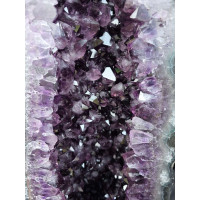
The thing I wear for this is a deep blue stone rather than a garment — a pendant from here that sits at the collarbone, close enough that I can see it in my peripheral vision while I'm talking to someone. It's a small blue edge in the corner of the room I carry around. On the days it makes me feel composed I keep it on. On the days it makes me feel walled off, I take it off, and that decision is the whole practice.
Back to the Drawer
I still have eleven shirts and seven of them are blue. I'm not going to pretend I've moved on to ochre. The difference is that on a Tuesday I now know which blue day it is — a choice or a hiding place — and the tells are small and reliable: the jaw, the length of my answers, whether I take the seat facing the door.
FAQ
Is blue actually calming, or is that just a story we tell?
Both, probably, and the honest answer is that the studies disagree in the details. What I trust is the part I can reproduce on myself: distance focus, slower breathing, a slightly wider sense of the room. Whether that's wavelength or association, my body doesn't seem to care.
What if blue makes me feel cold or shut out?
Then believe that, and use it. Plenty of people find blue impersonal rather than soothing, and in a lot of traditions it's a mourning color. The usefulness isn't in blue being good — it's in knowing what yours does, so you can pick it up on purpose. A color that reliably makes you feel separate is extremely useful information if you have a meeting you need to survive.
Does blue light at night really matter that much?
More than most people think and less than the gadgets sold to fix it. The mechanism is well described — short-wavelength light in the evening delays melatonin — but the size of the effect in ordinary life is modest, and one warm lamp does most of the work. I wouldn't buy anything. I'd move the bulb.
Should I avoid blue if I'm feeling low?
I wouldn't make it a rule. In my experience the relevant question is whether the color is helping you rest or helping you withdraw, and those feel different in the body even when they look the same in the mirror. If it's withdrawal, add one warm thing and go and stand near a window. If it's rest, rest.
Tags: color energy, blue, color psychology, cool tones
Related Pieces
View All →

You May Also Like
All Articles →

This content is copyrighted by its original authors. In case of any infringement, please contact us for removal.
Comments
Write a comment