What My 9:40 p.m. Second Wind Was Really Borrowing
By RedKnotr Editorial - 28/10/2026 - 0 comments
The question I answered too honestly at a dinner table
Two Fridays ago I was standing in a friend's kitchen at ten at night, holding a glass of water I didn't want, when someone asked how I still had energy. It was a compliment, the kind you're supposed to wave off. Instead I said: "I don't. I'm borrowing it." She laughed and moved on to the cheese. Four words, and roughly the whole of my energy management practice. I stayed there with the sentence, because I knew what the bill looked like. At 1:20 that morning I would be in bed with my phone six inches from my face, reading a thread about a subject I genuinely do not care about.
That's the thing about energy management that took me years to admit: the late-night burst is not a surplus. It's a loan with a variable interest rate, and the rate is set by how early I have to get up.
What the five layers of energy management say about 9:40 p.m.
The framework I work with reads a person in five layers. Physical — sleep, food, movement, breath. Emotional — boundaries, what I'm carrying for other people. Mental — attention, decisions, unresolved loops. Spiritual — whether the day connected to anything I actually value. Symbolic — the objects and rituals that mark a transition. Depletion rarely happens in all five at once, and that's the useful part: at 9:40 on a Friday, four of mine were fine and one was empty.
Physically I was tired in the ordinary way. Sleepiness arrives in waves rather than a straight line, and if you push past the evening window where sleep comes easily, alertness can rise again for a stretch. That second wind is a normal feature of the system. It is not evidence that you weren't tired; it's evidence that you missed the door.
Emotionally, the day had been entirely other people's. This is the pattern sleep researchers describe as revenge bedtime procrastination, and it has three fairly specific features: you delay sleep with no external reason forcing you to stay up, you know the delay will make tomorrow worse, and you do it anyway. The word revenge points at the motive. When the whole day is spent meeting demands, the late hour becomes the only unclaimed real estate left. Scrolling at midnight is usually a bid for personal time, which is also why strategies aimed only at the phone collapse within a week.
Mentally, my self-regulation was spent. Whatever capacity got me through work, commuting, dinner and the washing up was largely gone by ten, and the decision to stop scrolling was being made with the weakest resources of the day. Add the light: bright screens in the evening suppress melatonin and can delay the body clock, which is one reason the same hour feels different on a phone than in a paper book.
The energy management question I had been avoiding
For a long time my question was "how do I fall asleep earlier". The better question was "what is the late hour paying me for". When I actually wrote it down, the answer wasn't entertainment. It was quiet. Nobody needed anything from me between eleven and one, and I had been buying that quiet at the highest price in my day.
So I stopped trying to close the night and started paying myself earlier.
1. Name the payment, in one sentence
I sat with a notebook and finished this line five times: "At 11 p.m. I get ______." Unstructured time. Quiet. A break from being needed. Mine was quiet, plain and simple. Naming it made the behaviour look far less mysterious, and far less shameful.
2. Move twenty minutes of it to 4:10 p.m.
Every afternoon, before the evening rush, I now walk for twenty minutes without my phone. That's it. It felt absurdly small for the first week, and by the third week the pull toward midnight had loosened — not disappeared. The need was being partly met somewhere else, which is the only mechanism that has ever worked for me. Willpower applied to a phone has never survived a month.
3. A closing ritual at 9:40, not a cut-off
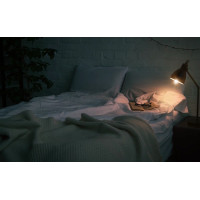
Hard rules fail for me because they remove something without replacing it. So instead of a phone ban, I have a shutdown, and it's three lines on paper: what got done, what's still open, the first thing tomorrow. Then one lamp instead of the ceiling light, and no new projects. The lines matter more than they look. Most of my late-night scrolling was a search for a stopping point, and a page with three lines on it is a stopping point you can see.
4. Give the energy a finite job
If I'm alert at ten, I try to spend it on something with an end. Fold the laundry for five minutes. Pack tomorrow's bag. Write the idea down instead of building it. What I avoid is the open-ended feed, because it removes every natural moment to quit — infinite scroll and autoplay are designed so that no stopping point ever arrives.
5. Fix the wake time, not the bedtime
The single change that has done the most for me is getting up at the same time whether or not the night went well. Sleep pressure rebuilds from the morning, not from the intention. Chasing a perfect bedtime made me anxious at 10:30 and awake at 11:30. A boring, regular morning fixed more than any evening trick.
There's a small ritual at the end of this that I've kept for years: I take off the moonstone pendant I wear — one of the quieter pieces from RedKnotr's pendant collection — and drop it in a shallow bowl by the lamp. It's a physical full stop, the only one in the house that doesn't require a decision.
What the loan actually costs
Ninety minutes a night doesn't stay ninety minutes. It compounds: attention, patience, appetite signals and mood regulation all get worse, and a depleted day makes the following evening more likely to end the same way. The trap I fell into for years was concluding I needed less sleep because six hours "worked". People are reliably bad at noticing their own impairment when sleep is chronically short. I was not the exception I thought I was.
Since Friday I've been asked the same question twice, and both times I gave the dull answer: I go to bed at eleven, mostly. Nobody wants that answer at a dinner party. It's the only one I've found that holds.
FAQ
Is a second wind a sign I slept well?
For me, no — it's usually a sign I pushed past the window. If it arrives at the same time every night and I feel wrecked by ten the next morning, that's the pattern talking, not a burst of health.
What if the quiet I want is genuinely unavailable during the day?
Then I try to steal it earlier and smaller rather than later and bigger. Twenty minutes at four o'clock is worth more to me than two hours at midnight, because I pay for the midnight version twice.
Do I have to give up my phone at night?
I didn't, and I don't think you have to. I moved the charger across the room, which is less about virtue and more about removing one reach. Some nights I still fetch it. The difference is that now it's a decision instead of a reflex.
Is this medical advice?
No. I'm not a doctor, and this isn't medical advice. If you're sleeping badly for weeks, snoring heavily, or falling asleep during the day, that's worth raising with someone qualified — a bedtime ritual won't touch sleep apnoea or an anxiety disorder.
Tags: second wind, energy management, bedtime procrastination, late night scrolling
Related Pieces
View All →



You May Also Like
All Articles →


This content is copyrighted by its original authors. In case of any infringement, please contact us for removal.
Comments
Write a comment