The Bead That Fell Out of My Bracelet Taught Me How Chakras Actually Pair
By RedKnotr Editorial - 28/10/2026 - 0 comments
The bead that fell out of my bracelet in October
Somewhere in the first week of October, a bead came off the bracelet I wear on my left wrist. Not the clasp, not a chip — one bead, clean gone, leaving a gap you can see when my arm is on the steering wheel. I noticed it at a red light on a Tuesday morning and felt an entirely disproportionate irritation. I looked for that bead in the car, under the bed, in the bathroom drain. It's gone.
For two years before that I had been working through the chakra system the way you'd work through a checklist: root month, sacral month, solar plexus month, all the way up, then start again. Diligent. Slightly mechanical. And in all that time I had never once sat with the gap between two centers, which is exactly what my wrist was showing me every morning. Chakra energy, it turns out, is less about the beads than about what runs between them.
The chakra map I had been reading as a ladder
Here's the map, roughly, as it comes down through the yogic and tantric traditions. Seven centers along the spine and above it, each with a Sanskrit name, a element, a colour, a number of petals and a domain of life:
- Muladhara, the root, at the base of the spine — four petals, earth, red, survival and safety.
- Svadhisthana, "her own abode", just below the navel — six petals, water, orange, desire, feeling, creativity.
- Manipura, "city of jewels", at the solar plexus — ten petals, fire, yellow, will and digestion in both senses.
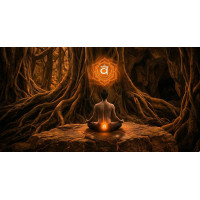
- Anahata, the "unstruck" sound, at the heart — twelve petals, air, green, love and connection.
- Vishuddha, "very pure", at the throat — sixteen petals, space, blue, expression and truth.
- Ajna, "command", between the eyebrows — traditionally two petals, sometimes counted as forty-eight, light, indigo, insight.
- Sahasrara, the thousand-petalled lotus, above the crown — no element, violet or white, pure consciousness.
What I had quietly turned that into was a ladder: get the bottom one right, climb, arrive. That reading is everywhere online and it is, in my experience, the least useful way to hold the system. A ladder implies that the lower centers are the beginner level you graduate from. Nothing in the older material supports that. The root isn't a rung. It's the floor.
Why chakra pairs made more sense to me than single centers
The first thing that loosened my checklist habit was noticing that the centers come in pairs across the axis of the heart.
Root and crown are the same current at two ends — one is safety in a body, the other is meaning in something larger. When my root is unsteady, my crown doesn't open into anything; it just floats. When I've been overreaching spiritually, my root is usually the thing that's thin.
Sacral and third eye pair desire with vision. You can't imagine something you have no appetite for, and you can't bring anything into form without being able to see it. When my sacral is flat, my Ajna work becomes abstract and slightly pretentious. When my Ajna is foggy, my creativity turns into restlessness.
Solar plexus and throat pair will with voice. Without confidence the voice has no weight; without a voice the confidence has no vessel. This is the pair I return to most, because it's the one that shows up in meeting rooms.
Anahata is the hinge — twelve petals sitting exactly where the three earth-bound centers meet the three sky-bound ones. Not a center among six others; the joint of the whole thing.
The chakra teaching that finally made the gap make sense
Then I found the granthis, and the missing bead stopped being a nuisance. In tantric literature there are three knots — granthi means knot — and here is the detail that reorganised everything for me: they are not located in the centers. They sit in the intervals between them.
- Brahma granthi, between root and sacral: attachment to survival and pleasure, the grip of the physical.
- Vishnu granthi, between solar plexus and heart: attachment to ego and emotional identity, the need for validation.
- Rudra granthi, between throat and third eye: attachment to insight itself, the subtle ego of being the one who knows.
Read that again slowly, because I didn't the first time. The blockages in this system live in the connective intervals, not in the nodes. Which means my two years of center-by-center work had me polishing beads while the string between them was knotted. The centers were mostly fine. The transitions were where I kept snagging.
There's a physical image that helped: three channels — ida, pingala, sushumna — with the centers forming where the side channels cross the central one. If that's the architecture, then the crossings are as real as the stations.
Practice one: the pair audit
One question per pair, asked sitting down with a hand on each end. Root and crown: "If I felt completely safe, what would I be aiming at?" Sacral and third eye: "What do I actually want, and can I see it?" Solar plexus and throat: "What am I not saying, and what would it cost to say it?" I don't answer quickly. I notice which end tightens first. For me it's almost always the upper one, which tells me the lower one is doing the work of holding something down.
Practice two: breathing in the interval
Instead of putting attention on a center, I put it in the space between two of them — say the span from navel to chest — and breathe there for eight breaths. No colour, no visualization, no lotus. Just the interval. It is much harder than it sounds and much less exciting than it sounds, and it's the practice I've kept longest. Around breath five or six something in the gap softens, and it isn't something I'm doing.
Practice three: one honest sentence a day
For the will-and-voice pair I gave myself a rule that isn't really a chakra exercise at all: one sentence a day that I would previously have softened, swallowed or wrapped in "does that make sense?". One. Some days it's about a deadline. Some days it's "I don't want to do that." The effect on the throat area was not instant and was not dramatic. It was, over about six weeks, a slow decrease in the amount of pressure I felt before speaking in the morning.
Practice four: the seven-name inventory
Once a month I write the seven names down the page and mark the one I've been avoiding. Not the one that's "blocked" — the one I don't want to look at. Then I look at its pair instead. Every single time, the pair is where the actual work is. The center I avoid is usually compensating for its partner.
I still wear the bracelet with the gap. I've thought about restringing it, and I'll get to it. In the meantime it does something a complete bracelet couldn't: it reminds me that the interesting part of chakra energy was never the bead. If you want a piece that carries the same idea, the beaded and stone-set pieces at RedKnotr do it more elegantly than a broken string does.
Where I've landed
I no longer believe I'm supposed to fix seven things. I believe I'm supposed to notice one interval at a time, and that most of what I called a blocked center was actually a knotted transition I'd been walking through too fast. The irritation at the red light has passed. The gap is still there, and most mornings I'm glad of it.
FAQ
Do I have to open all seven chakras?
I don't think so, and I've stopped trying. In my experience the system self-corrects when one interval gets attention. The idea of seven permanent projects is a modern checklist habit, not something the older texts ask of anyone.
How do I know which one to work on?
For me it's the one I don't want to write down. Failing that, I start with the pair that matches my current complaint — if I'm not speaking up, it's will and voice; if I can't see past next week, it's desire and vision.
Can I do this without believing in subtle energy?
Yes. I've never seen a chakra and I'm not certain what I'd be looking at. What I can verify is that putting attention in a specific region of my body, breathing slowly and asking a direct question changes what I notice. That's enough for the practice to be worth my morning.
Is this medical advice?
No. I'm not a doctor and this isn't medical advice. Pain, numbness, thyroid symptoms, persistent low mood — those go to a clinician. This is a body-based reflective practice and it sits beside that, not instead of it.
Tags: chakra pairs, chakra energy, granthis, seven chakras
Related Pieces
View All →





This content is copyrighted by its original authors. In case of any infringement, please contact us for removal.
Comments
Write a comment