My Head Felt Like a Jar Lid Screwed On Too Tight: Notes on the Crown Chakra
By RedKnotr Editorial - 18/10/2026 - 0 comments
The jar-lid feeling at the top of my head
It was 11 p.m. on a Sunday, screens finally dark, and I became aware of a strange tightness across the crown of my skull — like a jar lid screwed on one turn too far. Not a headache, exactly. More like the top of me was sealed while something underneath kept simmering. I'd spent that whole day ingesting: feeds, podcasts, half-watched videos, other people's opinions stacked on other people's opinions. My body had logged out. My head hadn't. I'd been reading about the crown chakra for months, and that night the map finally pointed at me.
My first instinct was to fix it the way I fix everything — reach for a technique, push hard at the spot, force an opening. That's when the crown chakra taught me its least convenient lesson: pushing is precisely the wrong motion up there.
What Sahasrara taught me by refusing to be forced
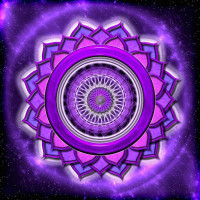
In the classical seven-chakra map, Sahasrara — the thousand-petaled lotus at the crown of the head — is the seventh and highest center. I used to skim it as "spiritual stuff," the least practical of the seven. What I've come to appreciate is that it's the only center whose element isn't an element at all: the texts call it pure consciousness, beyond fire, water, and the rest. Its colors are violet and white, its mantra isn't even a sound — it's silence, or the subtlest hum of Om. Where the lower centers map onto needs — safety, emotion, will, love, expression — the crown maps onto meaning and connection: how alone or held you feel inside the larger thing you're part of.
The imbalance readings, in my experience, are subtle and easy to misfile. An underactive crown shows up as disconnection and a flat lack of meaning — life continuing on schedule while something essential stops answering. The overactive version is sneakier and I recognize myself in it: living in the head, collecting spiritual ideas like souvenirs, using "higher perspective" to float above laundry, conflict, and the body's complaints. In this tradition that's called spiritual bypassing, and the tantric teachers are blunt about it: awareness is supposed to deepen your contact with ordinary life, not excuse you from it. The image that finally landed for me: the crown isn't a door you break open, it's a skylight that clears when the air below settles. The quieter I make the lower floors, the less tight the lid feels on its own.
Four small crown chakra practices from my notes
The three-minute sky pause
The simplest thing I do: step outside or to a window and just look at actual sky for three minutes, no phone, no narration. The first week I was shocked by how loud my own thinking sounded against that emptiness. By the second week the gap between "me" and "my thoughts" started showing up uninvited, in lines, in traffic. If you try one practice here, make it this one.
Resting awareness at the crown — gently
Sitting comfortably, long slow exhales, I rest my attention on the top of the head the way you'd rest a hand on a sleeping animal — contact without pressure. Some days there's a faint warmth or spaciousness. Some days it's just an itchy scalp and a to-do list. Both count; the practice is the not-pushing, not the fireworks.
The information sunset
Sixty minutes before bed, inputs stop — no feeds, no podcasts, no "just one video." The first three nights were genuinely uncomfortable, which told me how much noise my crown was processing daily. By the second week the jar-lid feeling mostly stopped visiting at 11 p.m. It's the least mystical practice in this article and possibly the most effective.
One unannounced kindness
Borrowed from the tradition's suggestion of selfless acts without reward: once a day I do one small useful thing and tell no one — washing the dishes nobody asked about, answering a stranger's question thoroughly, taking the neighbor's bin in. The effect isn't dramatic; it's a loosening, a small confirmation that connection doesn't require an audience.
An anchor on the windowsill
On my windowsill sits a small amethyst from RedKnotr — violet, which is part of why I chose it, though honestly it chose itself at checkout. Many people find purple or white stones a fitting companion for crown work; in my experience the stone doesn't do the quieting, it just marks the spot where I've agreed to practice it. Before bed I touch it once, on my way to drawing the curtain — the information sunset's physical bookmark.
The jar lid still shows up some Sundays, usually after a day of too much input. The difference now is that I recognize it as weather, not defect — a reading on one dial of seven, and a reminder to settle the lower floors before I go looking for light at the top.
Questions people ask me about crown chakra work
Do I have to believe in this for it to work?
I treat the chakra map as a lens, not a creed, and it's worked fine that way for me. You might notice something different, and that's fine — the sky pause is just standing still under open air; whatever meaning you assign it is yours to keep or discard.
What if I feel nothing at the crown?
Most days I feel very little up there, and I've practiced for years. The reliable signals for me are indirect: the quality of my sleep after an information sunset, or how quickly meaning returns after a flat week. Subtlety is normal at this center.
How is the crown chakra different from the third eye?
The way I've come to feel it: the third eye is about insight — seeing clearly within; the crown is about connection — belonging to something wider than your own thinking. Insight answers questions; the crown is what happens when, briefly, no question is running.
Can you work the crown while ignoring the lower chakras?
I tried, in my overactive phase, and mostly achieved elaborate daydreams. Every tradition I've read agrees with my experiment: the roots, gut, and heart need tending first, because the skylight only clears when the floors beneath it are in order.
Tags: crown chakra, sahasrara, chakra balance, chakra energy
Related Pieces
View All →




This content is copyrighted by its original authors. In case of any infringement, please contact us for removal.
Comments
Write a comment