I have tried, in strict order, four different ways to put an oval stone to work. None of them worked — at least, none of them worked the way I'd decided in advance they should. What I have instead is a small pile of honest failures and, finally, an understanding of what an ellipse actually is, which I could have gotten from one geometry lesson if I'd been willing to listen. Here is the list, in the order I tried them, because the order is the whole lesson.
First, I wore an oval as an upgraded circle — nothing happened
My theory was simple: I liked round stones for their evenness, so an oval must be a round stone with more of the good stuff. I wore an oval smoky quartz for two weeks expecting circle-calm, plus something extra. Nothing extra arrived. The failure taught me the first real fact: a circle is defined by one center, and an ellipse is defined by two focal points. A circle's pull is even in every direction; an oval's pull is directional. It leans. It was never an upgraded circle — it was a different animal wearing a similar coat.
Five ovals, five different ratios — I owned none of them when I wrote my first theory
Then I tried breathing along two focal points — I just got distracted
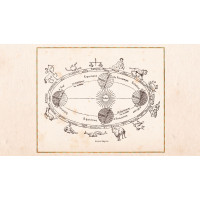
Reading up on ellipses, I learned the definition: every point on the curve sits at a constant combined distance from two fixed foci. It's a beautiful idea, so I made it a practice. I drew an ellipse on paper, marked the two foci, and spent a week breathing "from one focus to the other" during morning sits. Honest report: it mostly made me dizzy and slightly annoyed. Two anchors is one more than my attention wants at 6 a.m. What I salvaged from the wreckage was the actual insight, which is that an oval is a shape of off-center movement — the geometry of orbits. Kepler worked out that planets run on ellipses with the sun off at one focus. Nothing about an oval is meant to be centered. Some shapes hold still; this one travels.
I bought a 1.6-to-1 super-elongated oval — and met the bow tie
Failure number three was a purchase. I ordered a dramatically elongated oval stone, chasing that long, flickering line you see in jewelry photography. What arrived had a dead gray band across its middle — the "bow-tie effect," a shadow zone that shows up in stretched oval cuts when light fails to bounce back from the center. The pros will tell you a balanced oval lives around a 1.3-to-1.5 length-to-width ratio; the modern oval brilliant cut was perfected by Lazare Kaplan in the early 1960s, and the whole craft since has been about that proportion. My 1.6 stone was long at the cost of a dark midline, and wearing it felt restless in a way I couldn't articulate until I understood the optics: the shape had outrun its own light. In this tradition the lesson reads as caution about extremes; in the jeweler's tradition it reads the same way with numbers attached.
I flipped the stone point-up, point-down, sideways — orientation is real
The last experiment cost nothing and worked best. Because an oval is egg-shaped — the word itself comes from the Latin ovum, egg — it has an implicit direction: the narrow end points somewhere. Wearing the same oval pendant narrow-end-up versus narrow-end-down changed the whole line of how it sat on the chest; the egg shape carries old symbolism of birth, potential and continuity, and the vesica piscis — two overlapping circles whose lens-shaped middle preceded oval jewelry by millennia — stands behind that reading. I'm not claiming the stone does anything mystical when you flip it. I'm saying the geometry reads differently to the eye and the body depending on which way it points, and I had to wear it both ways for a week each to believe that. The pointing end, it turns out, does most of an oval's talking. When I finally said any of this out loud to a friend who designs jewelry, she laughed and told me that lens-shaped beads pointing toward the hand have been common in her sketches for years — the direction was obvious to her from day one, the way the two foci were obvious to Kepler, and obvious to everyone except the man who had to fail his way into it.
So, the accounting. I gave away the 1.6-to-1 restless one, I stopped pretending ovals are circles, and the one stone I've kept is a modest 1.35-to-1 oval moonstone from RedKnotr — long enough to have a direction, short enough to keep its light. It sits in the top drawer, narrow end toward the hinge, which is where it has lived since the frost started. If you want to try your own experiments with oval stones, wear one long enough to stop noticing it, then start noticing it — the geometry will introduce itself, some days more patiently than it introduced itself to me.



This content is copyrighted by its original authors. In case of any infringement, please contact us for removal.
Comments
Write a comment