The Ledger of the Heart: Giving, Receiving and the Fourth Chakra's Quiet Arithmetic (October 2026)
By RedKnotr Editorial - 11/10/2026 - 0 comments
Every energy centre in the chakra tradition asks a question. The root asks whether you are safe. The throat asks whether your truth has a way out. The heart — Anahata, the fourth centre, at the middle of the chest — asks perhaps the hardest one of the seven: can love move in both directions?
The Sanskrit name is usually translated as "unstruck" or "unhurt": a sound that arises on its own, without two things striking together. Tradition holds that this is what a settled heart centre feels like — connection that does not have to be earned, affection that is present without being forced. The image matters because so much of modern heart-talk swings between two extremes: the boundless yes of "keep your heart open at all costs" and the armoured no of "protect yourself from everyone". Anahata, as practitioners describe it, lives between those — a heart that stays warm precisely because it also knows how to receive.
The Ledger Metaphor
Think of the heart centre as keeping a quiet ledger. On one side, what you give: care, attention, patience, the labour of listening. On the other, what you allow in: compliments you actually absorb, help you actually accept, rest you actually take. A balanced ledger does not mean an exact 50-50 accounting every week — life is lumpy, and some seasons ask more giving than receiving. Balance, in this tradition, means the channel itself stays open in both directions.
Underactive patterns show up when the receiving side of the ledger stays closed: isolation, difficulty trusting, holding a grudge that has fossilised, loneliness in a crowded room, harsh self-criticism that would never be spoken to a friend. Overactive patterns show up when the giving side runs unchecked: over-giving, rescuing, an inability to say no, love that comes wrapped in self-erasure. Neither pattern, practitioners say, is a character flaw. They are habits of the channel — and channels can be retrained.
Compassion Fatigue: The Overdraft Condition
Anyone who gives care for a living or a life — nurses, therapists, teachers, parents, the friend everyone calls first — has met the condition that chakra language calls an overextended heart and clinical language calls compassion fatigue. The symptoms practitioners describe are familiar: emotional numbness, cynicism arriving where warmth used to be, feeling depleted rather than fulfilled by people you genuinely love.
The crucial reframe many teachers offer: compassion fatigue does not mean your compassion died. It means the person doing the caring has been left off the list of people being cared for. The heart centre, in this reading, is not a one-way pump. When the giving side runs for months without the receiving side engaging, the whole system throttles down to protect itself. Numbness is not failure; it is a circuit breaker.
The Unstruck Question
A practical question sits at the centre of this work, and it comes straight from the "unstruck" meaning of Anahata: what would it mean to be loved without performing for it? Many people find they can give love far more easily than they can sit still and receive it — receive a compliment without deflecting it, accept a favour without immediately repaying it, rest without earning the rest first. For them, the heart practice is not opening more. It is standing still long enough to let something in.
Six Gentle Practices for the Fourth Centre
Nothing here requires belief, equipment or experience. Choose one and try it for a week; the tradition holds that consistency matters more than intensity.
- The receiving window. Once a day, accept something without repaying it on the spot — a compliment, a door held open, an offer of help. Notice the flinch. Let it pass un-acted-upon.
- One written thanks. Each evening, note one specific thing someone did that mattered to you. Once a week, tell them. Gratitude, practitioners say, turns the attention back toward connection on both sides of the ledger.
- The friend voice. When the inner critic starts, ask what you would say to someone you love in this exact situation — and say that, to yourself. The receiving side of the ledger includes how you receive your own imperfection.
- Breath at the chest. Sit tall, rest a hand at the centre of the chest, and breathe into that space for two minutes. On the inhale, the tradition suggests imagining warmth arriving; on the exhale, letting one grievance soften by a single degree.
- The two-way sentence. Practitioners of heart-centred work often use the phrase: "My heart can stay open while my boundaries stay clear." Repeat it before situations where you tend to over-give — the family call, the extra shift, the friend who only calls in crisis.
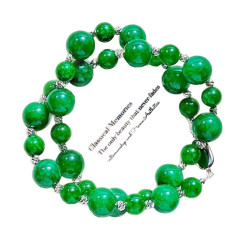
- One stone, one pocket. Many people like a physical anchor for the practice. Green stones — green aventurine, jade, emerald — are traditionally paired with the heart centre, and rose quartz with tenderness and self-regard. Carried honestly, a stone is not a fix; it is a cue. When your hand finds it, it asks the day's question: is the channel open in both directions right now? You will find heart-centre stones set into wearable pieces at redknotr.com.
A Note on Honesty
Chakra work belongs to a symbolic and spiritual map, not to anatomy, and no energy practice treats a medical condition. Persistent chest tightness, numbness or hopelessness deserves a real conversation with a qualified professional. Practitioners who work this way treat the heart centre as a language for noticing patterns — a mirror, not a prescription. Held that way, it does what maps do best: it makes the invisible geography of your habits visible enough to change.
The Weeklong Experiment
Here is a simple structure for the coming seven days. Pick your dominant pattern first. If you over-give, the experiment is a boundary a day: one small, kind, clear no. If you under-receive, the experiment is an acceptance a day: one small, awkward, genuine yes to help. Keep a one-line ledger each evening — gave, received, noticed — and on the seventh day read it back.
Most people find the entries reveal something the mind had been smoothing over: the imbalance is real, but so is the fact that it moves. A ledger that moves can be rebalanced. That is the quiet promise at the centre of Anahata — the heart is not a fixed amount of warmth rationed out until it runs dry. Practitioners describe it as a spring rather than a wallet: fed by the same love it pours out, provided the inflow is left open.
Frequently Asked Questions
What does an unbalanced heart chakra feel like, according to the tradition?
Practitioners describe two directions. An underactive heart centre leans toward guardedness, isolation, resentment and fear of closeness; an overactive one leans toward over-giving, rescuing, co-dependence and losing your own edges in other people's needs. Both are read as a channel stuck in one direction rather than a permanent state.
Which crystals are traditionally used for the heart chakra?
Green stones lead the list — green aventurine, jade, emerald and malachite — with rose quartz commonly paired with tenderness, self-compassion and gentle receiving. In practice the stone works as a tactile reminder of an intention, not as a treatment; choose the one you will actually touch.
Can compassion fatigue really be helped by heart-centre work?
Practices such as rest, boundaries, self-compassion and reflective journaling are commonly recommended for compassion fatigue, and many people find the heart-centre framing gives them a useful language for it. It is a support practice, not a substitute for professional help when exhaustion or low mood runs deep.
How long before a heart chakra practice "works"?
Most teachers suggest a week of one small daily practice before evaluating, and a month before expecting any settled change. The honest framing: you are not waiting for an external result but noticing whether the channel of giving and receiving has become easier to keep open.
Tags: heart chakra, anahata, compassion fatigue, chakra balance, giving and receiving
Related Pieces
View All →





This content is copyrighted by its original authors. In case of any infringement, please contact us for removal.
Comments
Write a comment