A Stair Is Not a Spiral: What the Helix Adds in the Third Dimension (November 2026)
By RedKnotr Editorial - 03/11/2026 - 0 comments
Look closely at almost any "spiral staircase" photo and you will find an impostor. The steps do not spiral inward toward a centre; they circle a central pole at a constant distance while climbing steadily. That shape has a different name, and the difference is not pedantry - it is the whole meaning of the form.
The Difference in One Paragraph
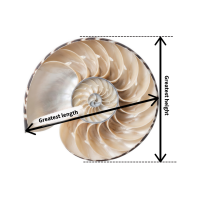
A mathematical spiral lives on a flat plane: it winds around a point while its distance from that point changes, shrinking toward a nautilus or flaring outward. A helix lives in three dimensions: it circles a fixed line - the axis - always at the same distance, while rising along it at a steady rate. A spiral asks "how far from the centre?" A helix answers a different question: "which floor?" One is a curve that returns to where it began; the other is a curve that returns to the same coordinates one level up.
Chambord: Two Routes, One Tower
The most famous helix in architecture stands at the exact centre of the Château de Chambord in the Loire Valley, begun in 1519. Two stone ramps wind around a shared, partly hollow core, one above the other, and never touch. Two visitors who take different entrances at the bottom can see each other through the openings the whole way up, wave at every landing, and arrive at the roof terraces together without ever having met. The château lists the staircase among the hints of Leonardo da Vinci's influence - sketches of double-helix towers survive in his notebooks, and he was at the French court when work began - though no document proves his hand.
The design solved a real traffic problem, which is why it keeps reappearing. The grand staircase in the Vatican Museums that everyone calls the Bramante staircase is actually Giuseppe Momo's 1932 double helix - one ramp up, one down, engineered so that flowing crowds never collide. Santiago de Compostela has a rarer triple-helix stair from around 1700. Even medieval castle stairs, the single-ramp kind, encode geometry as strategy: many wind clockwise so that defenders above had room to swing a sword while attackers below did not, as historians of architecture widely note.
The Helix in Your Hand
Once you know the definition, helices turn up everywhere in daily life: the thread of a screw, the lid of a jar, a corkscrew, a coiled cord, the rails of a spiral stair. The shared trick is quiet power - a helix converts turning into travel. Twenty rotations of a screw advance it centimetres into oak with a force your wrist could never apply in a straight push. And in 1953 the double helix became the most consequential shape in biology when the work of Watson, Crick, Franklin and Wilkins revealed DNA's two intertwined strands - two routes, one ladder, the same architecture Chambord built in stone four centuries earlier.
What the Helix Suggests About Practice
In the symbolic layer, tradition holds that shapes suggest rather than command - and the helix suggests something specific. A spiral habit circles: the argument you have every March, the resolution that returns every January at the same radius. A helical habit revisits the same theme at a different level: the same conversation, one floor up. A useful monthly audit is to sort your routines that way. Which ones are genuinely loops - same circle, same view? And which are helices that only look like loops because the axis is the same? The question to ask is not "am I back where I started?" but "am I back at the same coordinates, one floor higher?"
Jewellery has always borrowed the form - twisted rope chains, barley-twist bangles, spiral pendants that catch light as they turn. If the shape means something to you this month, the pieces at redknotr.com include several that carry the motif in wearable size.
Frequently Asked Questions
So is a spiral staircase actually a helix?
Almost always yes. The common kind winds around a central pole at constant radius while rising - a helical stair. The word spiral stuck through everyday usage, and the strict names matter mainly when the distinction carries weight, as in Chambord's two non-touching ramps.
Are helices better than spirals?
No - different jobs. Planar spirals model growth and contraction in two dimensions, like a nautilus shell; helices model climbing and transport in three. Neither is superior; they answer different questions.
Why does the double helix fascinate people so much?
It separates without disconnecting: two paths that share an axis, see each other, and never collide. Architecture uses that for crowds and ceremony; biology uses it to carry a genetic code. The same form solves the same problem at very different scales.
How can I use this in a daily geometric-energy practice?
Try the audit above, and add a noticing walk: find one planar spiral and one helix in your week - a shell, a stair, a jar lid - and let the difference remind you to ask which of your own routines are loops and which are climbs.
Tags: helix, spiral staircase, sacred geometry, geometric energy
Related Pieces
View All →


You May Also Like
All Articles →
This content is copyrighted by its original authors. In case of any infringement, please contact us for removal.
Comments
Write a comment