Circle, Square, Triangle, Spiral: A Working Vocabulary for Shape and Geometric Energy
By RedKnotr Editorial - 11/10/2026 - 0 comments
A shape is a decision about structure, and structure is legible. When something is arranged in an orderly, symmetrical way, we read it as stable — and we read the opposite just as quickly. Shape and geometric energy starts from that observation: ordered structure reads as a stable field, and because of that, different shapes carry different qualities into a room, an object, or a piece of jewellery.
Why Orderly Structure Reads as Stability
The reasoning runs through two routes. In the traditional route, geometric forms are treated as crystallised intention — a triangle is not merely drawn, it is a particular kind of containment. In the psychological route, the effect is about attention: a symmetrical figure gives the eye a resting place, and a mind that has found a resting place reports calm. Both routes point at the same practical result, which is why the practice is useful regardless of which explanation you prefer.
This intersection is old. Mandalas from several traditions are built on a central point with radiating symmetry, and observers have long noted that symmetry itself seems to do part of the work. Structured, symmetrical patterns are widely reported to be more settling than unstructured ones, which is consistent with the idea that predictability is itself soothing.
The Basic Vocabulary
Circle
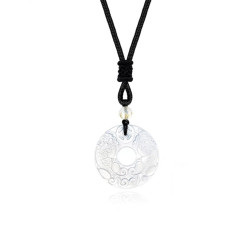
Wholeness and continuity — no beginning, no end, no corner to catch on. Circles suit anything about cycles, return, and completeness. As a piece, a round form tends to feel enclosing rather than directional.
Square
Foundation and boundary. The square says this area is defined, which makes it useful for grounding work, establishing a sense of territory, and setting limits. In many mandala traditions the square represents the solid, material level of experience.
Triangle
Direction and aspiration. An upward triangle reads as reaching toward a goal; the inverted form reads as returning to ground. Triangles are the most obviously intentional of the basic shapes, because they always imply a destination.
Spiral
Growth and unfolding. The spiral has a centre but no fixed boundary — it implies that the same theme will be revisited at a larger scale. Many traditions associate it with transformation over time rather than with any single state.
Star and radial forms
Expansion and outward signalling. The number of points is part of the meaning: three reads as creative and dynamic, four as stable and grounded, six as harmonising, eight as balanced and disciplined. Radial forms do not hold a centre quietly; they project from it.
Hexagon and lattice
Order and interconnection. Repeated geometric tiling communicates system and reliability rather than singularity, which makes it a good choice for anything about consistency over time.
Matching Form to Temperament
The pairing method that many practitioners use is to work from the quality of the sign rather than from its name. Read the sign's element and mode, then choose a shape that supports it.
Fire signs (Aries, Leo, Sagittarius)
Fire is expressive and forward-leaning: upward triangles, stars, and open forms suit it. Closed, heavy geometry tends to feel restrictive here.
Earth signs (Taurus, Virgo, Capricorn)
Earth is structural and durable: squares, hexagons, and compact symmetrical forms are the natural match, and heavier materials reinforce them.
Air signs (Gemini, Libra, Aquarius)
Air is relational and mental: circles, intersecting lines, and layered lattices suit it well, particularly in lighter, thinner materials.
Water signs (Cancer, Scorpio, Pisces)
Water is fluid and inward: spirals, soft ovals, and enclosed curves. Hard angles can feel jarring against a water temperament, which is why rounded forms and flowing lines are usually the better recommendation.
Material and Placement Amplify the Shape
The form is not the only variable. Texture and weight matter — a heavy metal square reads quite differently from a light wire square. Conventionally, some pieces are worn high near the throat for expression and clarity, others at the chest for connection, and rings or bracelets at the hands for daily action. None of this is fixed law, but the placement tends to determine how often you actually notice the object, and noticeability is most of the mechanism.
How to Use Shapes Without a Formal Practice
You do not need a ritual to get value here. Choose one shape that corresponds to the quality you are trying to hold this season — say, a square for a period of rebuilding boundaries, or a spiral for a period of gradual change — and keep it somewhere you will see it daily. Let it stand for one sentence. Within a few weeks, seeing the shape will call the sentence to mind, which is the whole intention.
If you would like that shape to be something you wear rather than something you keep on a shelf, our geometric and zodiac pieces are designed with exactly this daily reminder in mind.
FAQ
Do I have to match my shape to my zodiac sign?
It is a useful starting point, not a requirement. A given stone may pair naturally with earth signs, but if it does not suit where you currently are, that outweighs the convention.
Can I combine several shapes?
Yes, and layering is common. The practical guideline is to let one shape lead and use the others as support, so the piece still communicates a single intention.
Do geometric patterns in a room have the same effect?
They work on the same principle. A repeating pattern gives the eye structure, which reads as order. The effect is usually subtler than a worn piece simply because you notice your jewellery more often than your wallpaper.
Is there a wrong shape to choose?
Only one that means nothing to you. A shape you cannot connect to a sentence will not hold attention, and attention is the active ingredient.
Tags: Geometric Energy, Sacred Geometry, Shape Meaning, Zodiac Match

This content is copyrighted by its original authors. In case of any infringement, please contact us for removal.
Comments
Write a comment